


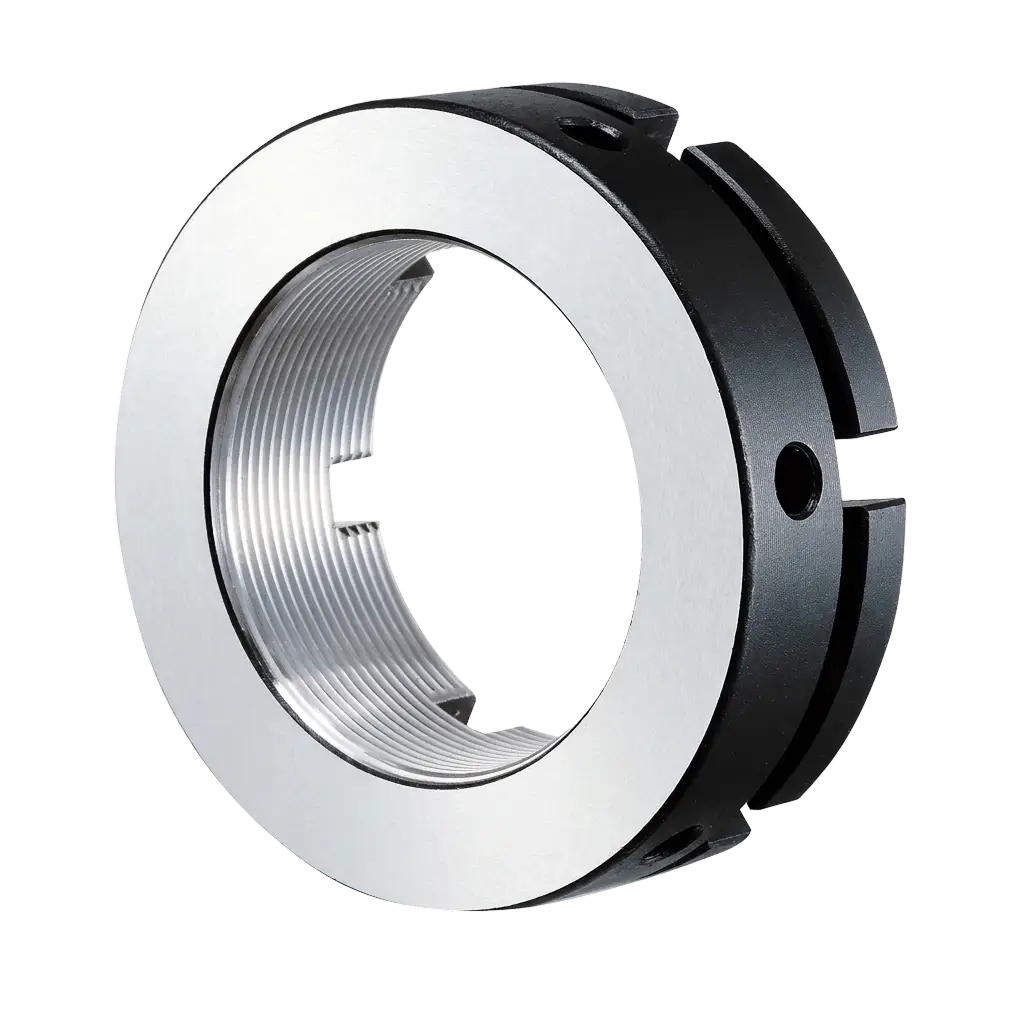
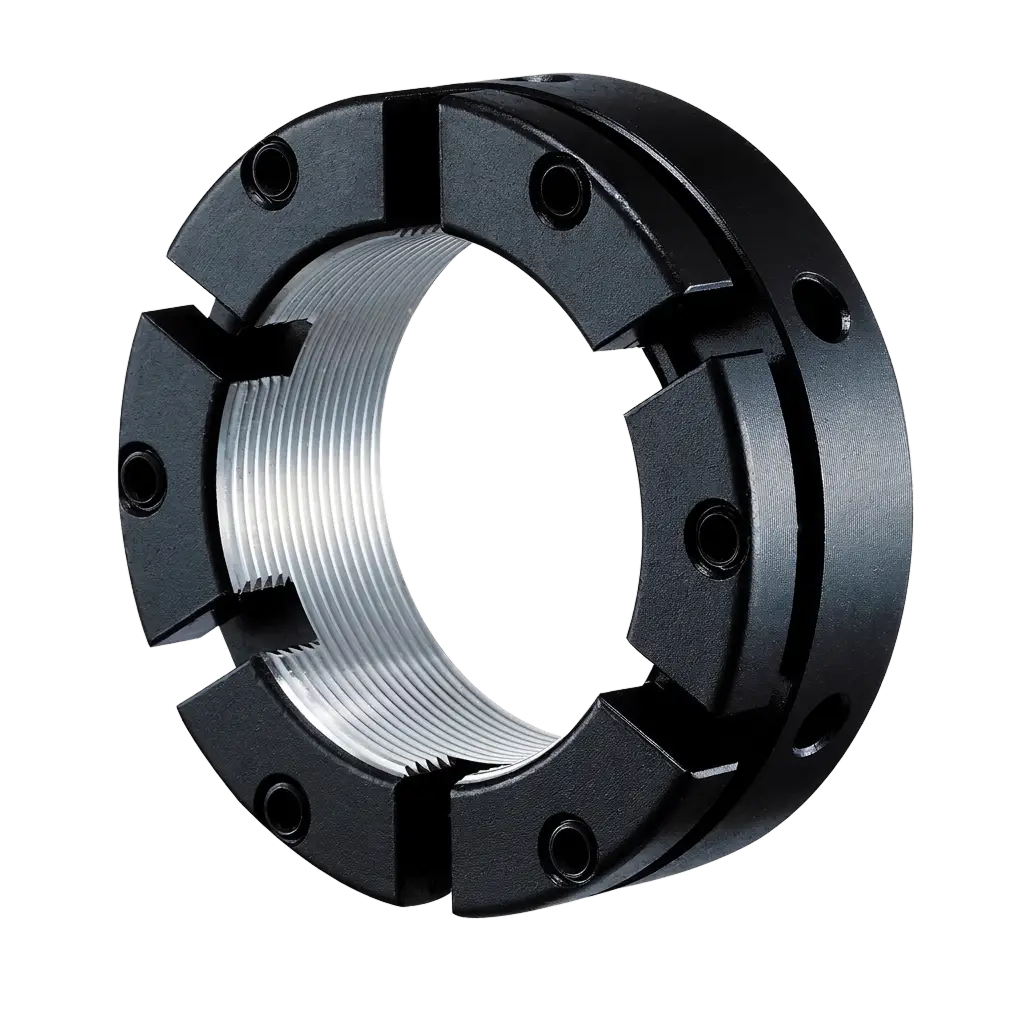
How MKK Locks From the Front Face
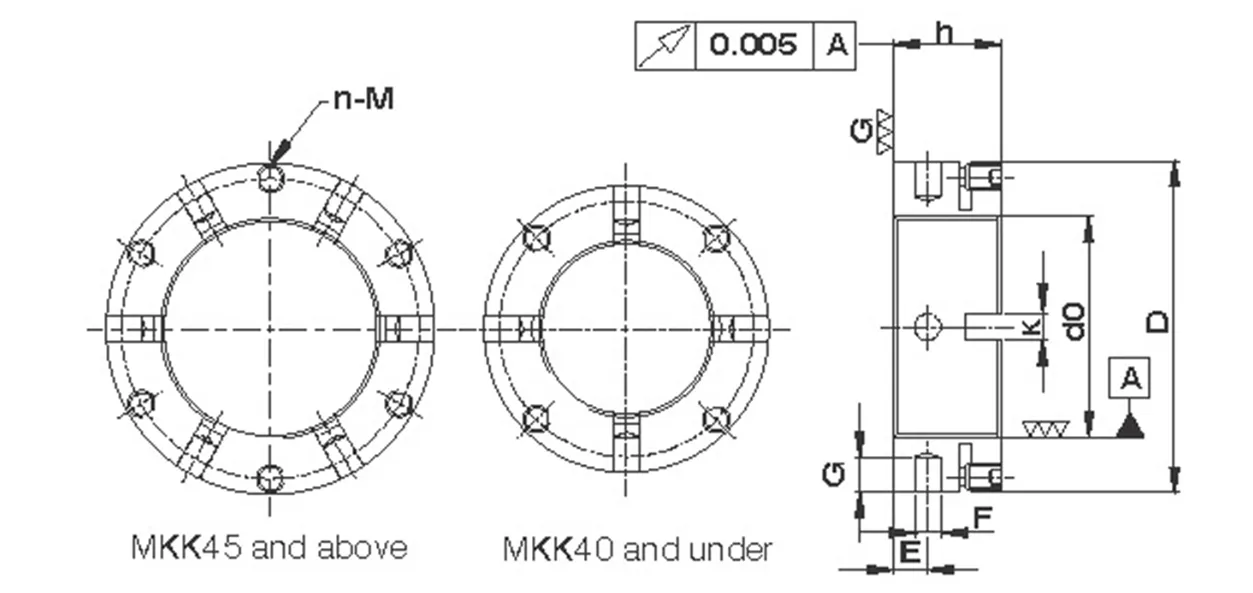
MKK locks with clamping screws driven straight down the axis rather than in through the outside diameter. The hex key approaches the nut head-on, so nothing has to reach the flank, and the nut can be secured after a bearing bore, a housing shoulder or an adjacent component has closed around it. Four screws carry the load to MKK40, six from MKK45, and eight from MKK95 upward.
The full explanation is on the Axial Locking Series page.

Locked From the Front Face
Screws parallel to the shaft axis
Bodies of 18 to 32 mm
Three threads in a second outside diameter
Ground Contact Surface
Maximum axial run-out 0.005 mm
4 to 8 Clamping Screws Per Nut
M5 to M10. 4.8 to 36 Nm max
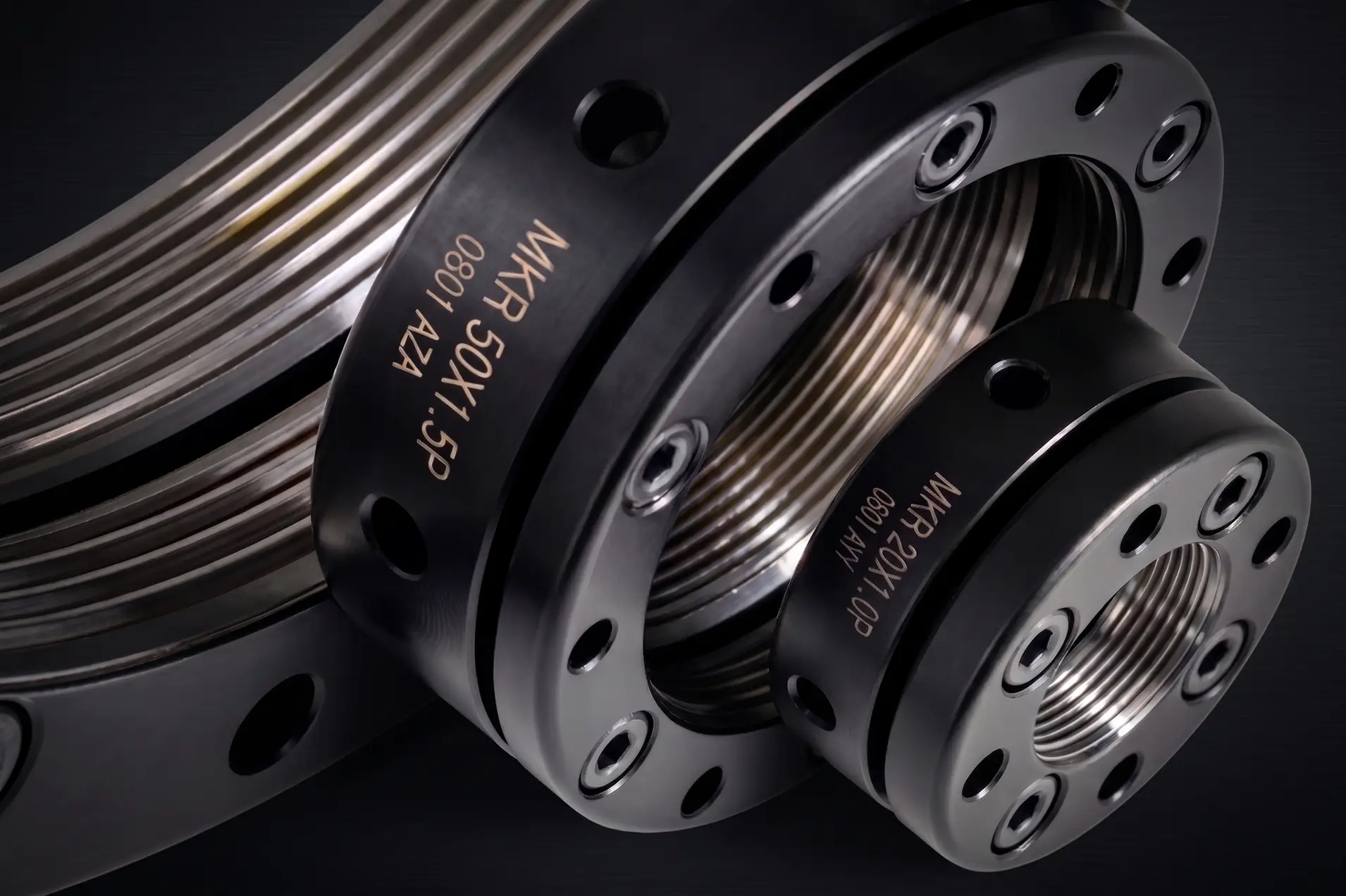
Where MKK Locknuts Are Used
Bearing retention in recessed and counterbored housings, where only the front face of the nut stays reachable
Assemblies wanting more clamping force than the rest of the axial series provides, up to M10 screws at 36 Nm
Large-diameter arrangements to M130 x 2 in a body no taller than 32 mm
The same shaft thread on two different contact faces, using the second outside diameter listed at M30, M35 and M40
Gearboxes, drive ends and pump housings opened at service intervals
MKK Specifications
Please enter your specifications below to find the right product for your project. Machined from JIS SCM440 / DIN 42CrMo4 per ISO 683-2, HRC 28-32, threads to class 4H per ISO 965-1. MKK40 and under use a different body form from MKK45 upward. Three threads carry a second entry named by outside diameter: MKK30/65 and MKK40/85 are larger across than the standard body on the same thread, while MKK35/58 is smaller.
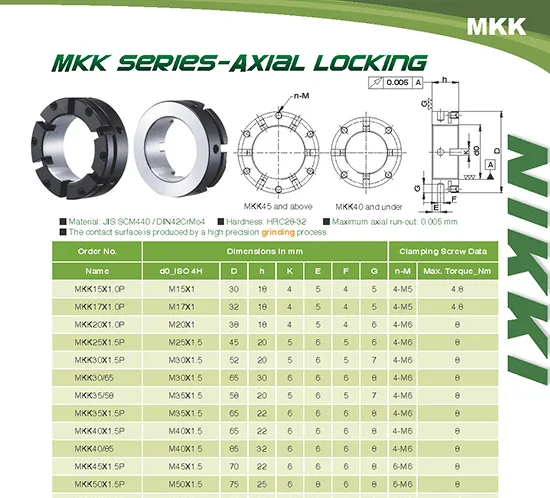

Find Your Size(M15 to M130)
Filter MKK locknuts by shaft thread, pitch, or height.


Products in this Axial Locking Series
All four lock the same way, with screws driven through the front face parallel to the shaft, so the nut can be secured with its outside diameter buried. What differs is the finishing grade, whether the nut takes clamping screws or set screws, how many of them carry the load, and how much body height the type asks of the design.
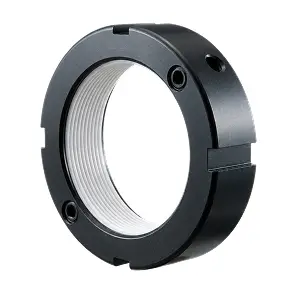
MA
0.002 mm
Two set screws · four wrench slots
M17×1 to M200×3 · h 15–37 mm
MA is the accuracy type in the series, ground on the thread area as well as the contact surface. It also carries the heaviest screws in the axial range, M12 at 56 Nm from MA135, spread over two positions rather than four or six.
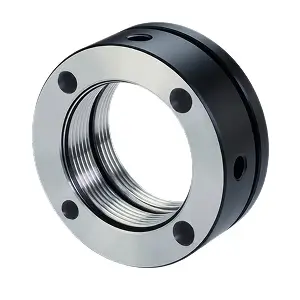
MKR
0.005 mm
Clamping screws · three to eight per nut
M10×0.75 to M200×3 · h 14–40 mm
MKR is the general-purpose axial locknut and by a wide margin the densest range NIKKI makes, at 58 sizes. It reaches M10 x 0.75, the smallest thread in the series, and it is the type to look at whenever the thread falls between the usual steps. MKR10 to MKR15 use a different body form from MKR16 upward.
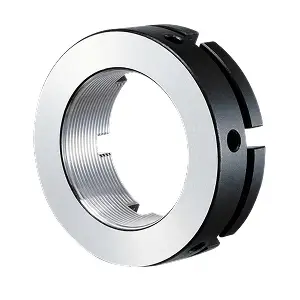
MKK
0.005 mm
Clamping screws · four to eight per nut
M15×1 to M130×2 · h 18–32 mm
MKK carries the heaviest clamping screws in the series, M10 at 36 Nm from MKK75, in a body no taller than 32 mm. Three threads, M30, M35 and M40, are listed in a second outside diameter, larger on M30 and M40 for a bigger contact face, smaller on M35 to fit a tighter housing bore.
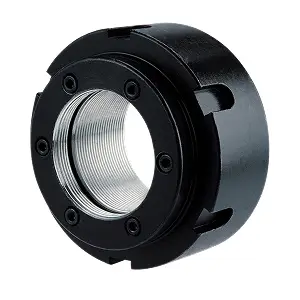
MKW
0.005 mm
Clamping screws · four or six per nut
M20×1.5 to M70×1.5 · h 28–46 mm
MKW is the tall type, 28 to 46 mm of body where the rest of the series runs 14 to 40 mm, which suits designs that would otherwise carry a separate spacer. The height sits in the code: MKW40-28 stands 28 mm high, MKW40-44 stands 44. Most threads to M50 are offered in two heights, and MKW runs a little softer than the others at HRC 25-28.
Tell Us What You Need. We'll Find the Locknut.

Give us the locknut code you use now and we'll find the NIKKI equivalent.

Describe the job, thread size, space, load, and we'll point you to the right NIKKI series.
Questions About the MKK Locknut
The MKK is the heavy-clamping axial locknut in NIKKI's Axial Locking Series, in metric threads from M15 x 1 to M130 x 2 with 0.005 mm maximum axial run-out. The questions below are the ones buyers ask before a first order.
Contact UsThe maximum axial run-out of an MKK locknut is 0.005 mm. NIKKI finishes the contact surface by a high-precision grinding process, which is what sets the run-out at this level. Where a drawing calls for 0.002 mm, the MA locknut in the same series has the thread area ground as well.
Each MKK size lists a catalog maximum per screw in the dimension table: 4.8 Nm on the M5 screws of MKK15 and MKK17, 8 Nm on the M6 screws fitted through to MKK50, 19 Nm on the M8 screws from MKK55, and 36 Nm on the M10 screws from MKK75 upward. Tighten gradually and alternately rather than driving one screw fully home first.
It is a second entry on the same thread, named by outside diameter rather than by pitch. MKK40 x 1.5P stands 22 mm high on a 65 mm outside diameter, while MKK40/85 stands 32 mm high on an 85 mm one. M30 and M35 carry a second entry as well, so check both the height and the diameter against the housing before ordering.
Add L to the order code for a left-hand thread (MKK30x1.5P-L) or U for an inch thread (MKK30-U18). Standard right-hand metric versions are ordered by the plain name, for example MKK30x1.5P.
Choose the MKR locknut where the thread sits outside MKK's range, whether below M15 or above M130, or where an intermediate thread is needed, since MKR carries 58 sizes against MKK's 25. Choose the MKW locknut where the design wants a tall body, as MKW runs 28 to 46 mm high and can take up length a separate ring would otherwise fill. MKK remains the type to specify when the clamping force matters and the body has to stay short.
No. MKK locks through clamping screws driven into the front face of the nut, so nothing else goes on the shaft. The shaft keeps its full section strength, no slot has to be cut, and the nut is reusable if handled properly.