


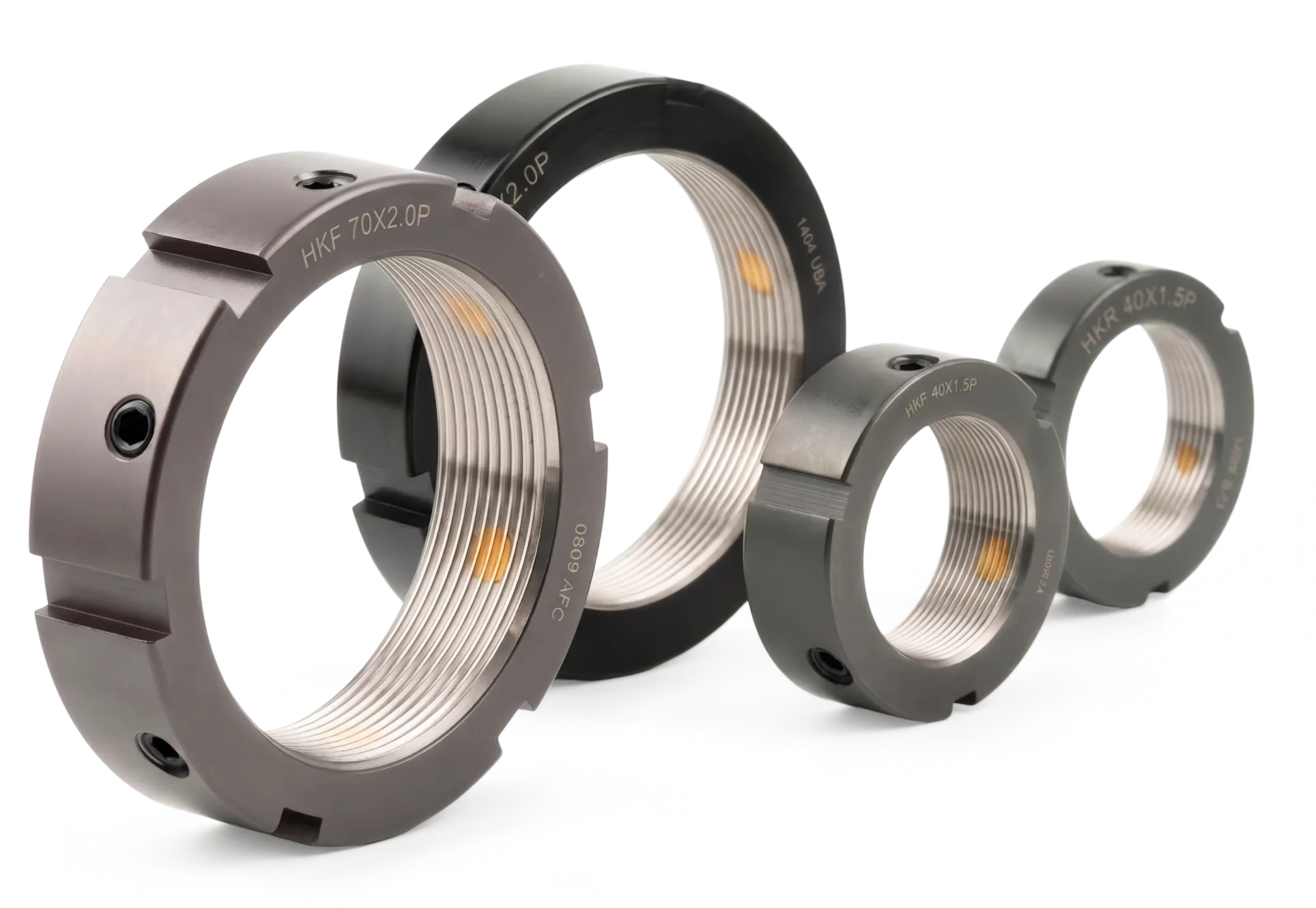

Why the Optimum Locknut Flank Angle Matters
Conventional locknuts lock at a fixed 30° flank contact, where tightening torque and flank pressure can diverge under load.
NIKKI's flank angle keeps the two within 10% of each other, so the preload you set is the preload the bearing sees. Thread and contact surface are finished by high-precision grinding.

Integrity

Prevents loosening
Vibration works on any unevenness in flank pressure, and the micro-movement it causes is what backs a nut off over time. With locking torque and surface pressure held within 10% of each other, the flank carries load evenly and that mechanism never gets started.

Maintenance
Prevents overheating
Pressure peaks at the thread contact turn into friction heat as the assembly rotates, and heat is the enemy of bearing preload. Uniform flank pressure spreads the load across the contact, keeping heat generation low where spindles run fastest.

Flexibility
Prevents noise
Contact noise comes largely from pressure peaks and micro-movement at the thread interface. The ground contact face and even flank pressure suppress both sources.

Accuracy
True running
The thread and contact surface are finished in the same high-precision grinding process, holding axial run-out within 0.002 mm on every size in both series. Locking accuracy carries straight into running accuracy at the bearing.
Choosing Between HKF and HKR
HKF and HKR are the same locknut in two body heights. Both use NIKKI's unique flank angle, both are ground to 0.002 mm axial run-out in SCM440 at ISO 4H, and both cover M15 × 1 to M200 × 3 in 42 sizes. HKR is exactly 6 mm shorter at every size, and from M25 upward that height is the only dimension that differs between them.
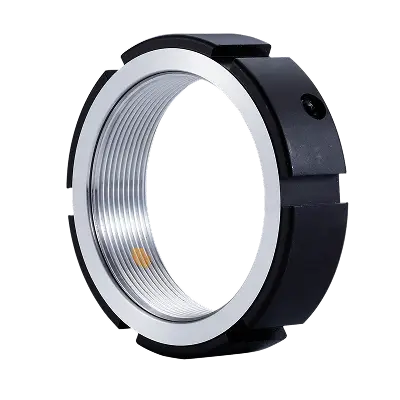
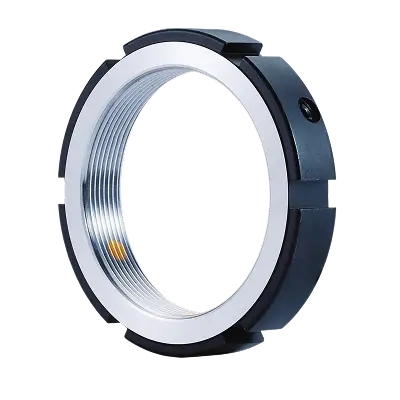
Other Locknut Series Available
For standard-duty locking at lower cost, the 30° Flank Locking Series (MF, BF, TMF, SFZ, MFZ, BFZ) covers most general machinery. Where a thin nut must lock from the outside diameter, see the Radial Locking Series; where the OD is inaccessible after assembly and locking is only possible from the front, the Axial Locking Series.
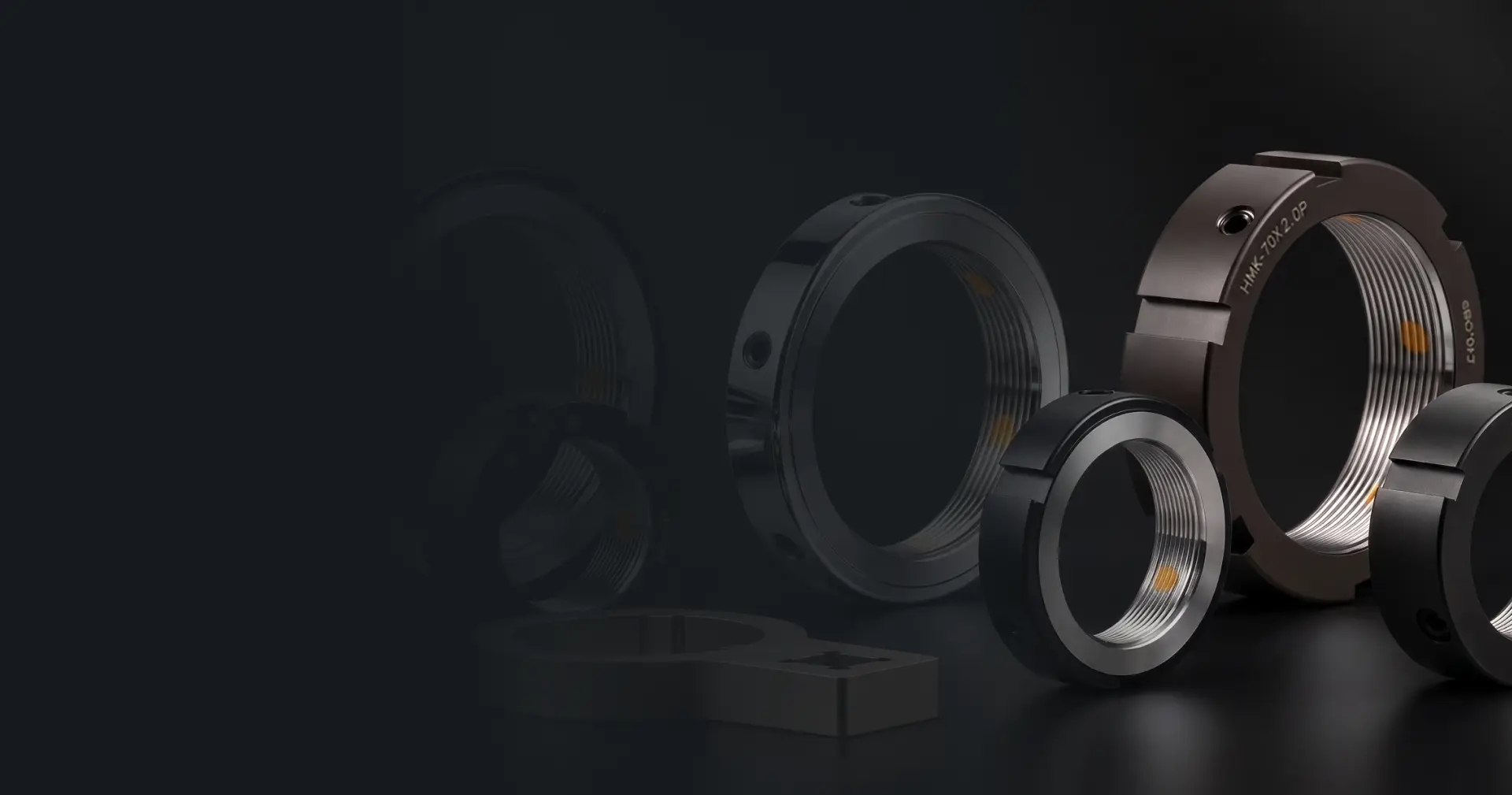
Ultra Uniform Locknut Applications
These are grinding-grade locknuts, specified where preload stability and running accuracy justify the cost over a precision-turned nut. Anywhere a bearing or screw is preloaded on a rotating or reversing axis is a candidate.
Machine Tool Spindles
Bearing retention at the front and rear ends of milling, turning, and grinding spindles, where preload stability sets the ceiling on speed and surface finish.
Ball Screws
Holds pre-tension at the fixed and motor ends of ball screw support bearings under constantly reversing loads, protecting positioning accuracy over the axis's life.
Rotary Tables & Index Heads
A nut that holds its preload holds the indexing repeatability with it, through years of clamp-and-release cycles.
Robots & Automation
Joint drives and reducers see reversing torque all day; vibration-proof locking without a keyway suits compact joint designs.
Linear Stages & XY Tables
Bearing retention on precision positioning axes in production and measuring equipment, where micro-loosening shows up directly as lost accuracy.
High-vibration Assemblies
Conditions that gradually loosen conventional locknuts. The even flank pressure removes the micro-movement that vibration exploits.
Shafts That Can't Take a Keyway
Locking needs no thrust washer or keyway, so the shaft keeps its full section strength and a machining operation is saved.
Shared Specifications
Tell Us What You Need. We'll Find the Locknut.

Give us the locknut code you use now and we'll find the NIKKI equivalent.

Describe the job, thread size, space, load, and we'll point you to the right NIKKI series.
Questions About This Product
The series locks at NIKKI's special flank angle instead of the conventional 30° contact. This keeps the difference between locking torque and thread surface pressure within 10%, a level of uniformity a fixed 30° flank doesn't reach, which prevents loosening, overheating, and noise more reliably.
When torque and flank pressure diverge, parts of the thread carry more load than others. Under vibration and speed, that unevenness allows micro-movement at the contact, and the nut gradually backs off. Holding pressure uniform across the flank removes the mechanism that starts the loosening.
No. Both series lock through set screws acting on the flank angle, so no thrust washer or keyway is required. This simplifies assembly and avoids cutting a keyway into the shaft.
Yes, both series are reusable if handled properly. They're designed for easy assembly and disassembly, which suits maintenance work on spindles and bearing arrangements.
Both series are machined from JIS SCM440 chromium-molybdenum steel (DIN 42CrMo4) at HRC 28-32, with thread and contact surface ground to ISO 4H thread precision.