


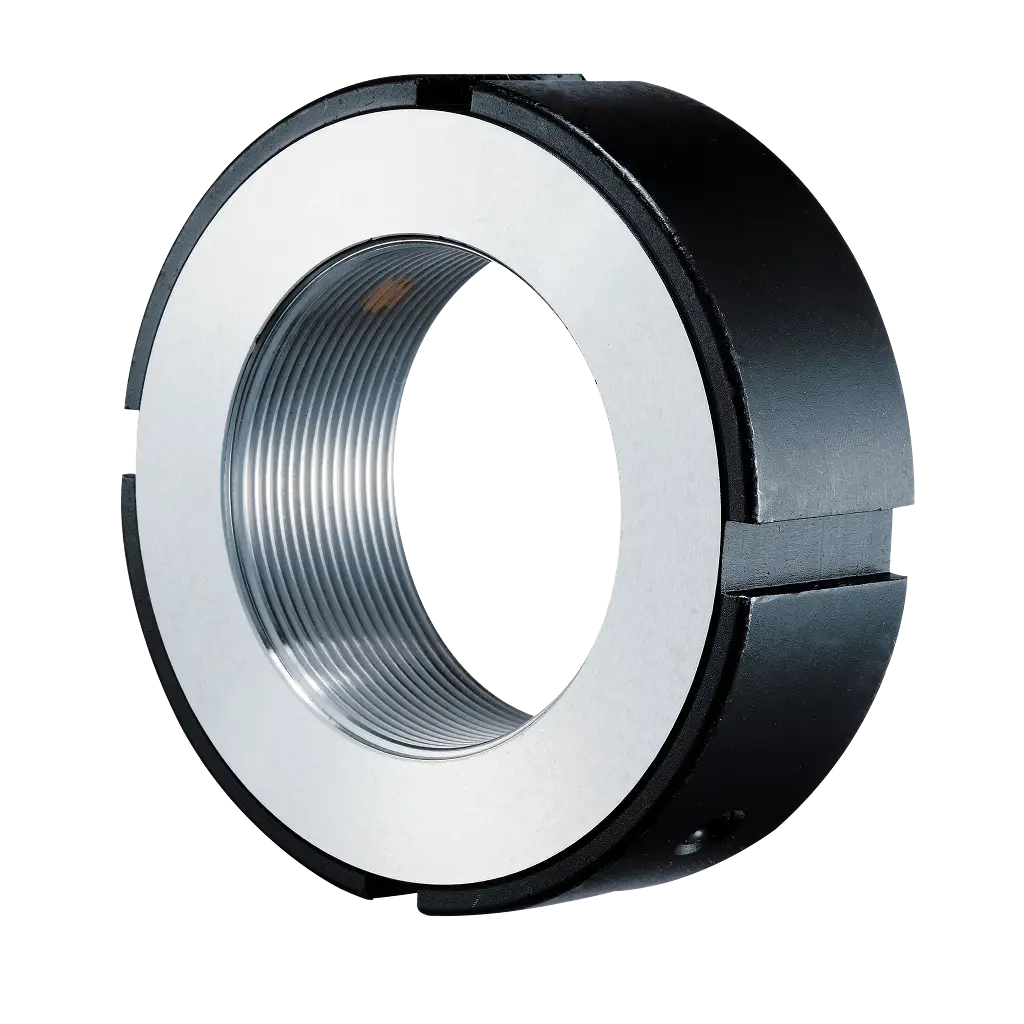
How MRRA Locks at 90° to the Shaft
MRRA locks through a brass pad rather than through the set screw itself. Each of the two screws enters through the outside diameter, meets the shaft at 90°, and drives its pad onto the thread flank, spreading the load along the flank instead of denting the crest. Where MRRA departs from the rest of the series is in what surrounds that mechanism: more body around the thread, and on most sizes a choice of outside diameter.
The full explanation of the locking principle is on the Radial Locking Series page.

Built for High Radial Torque
Taller, heavier body than the series
Two Outside Diameters Per Thread
M50 x 1.5 at 75 mm or 92 mm
Ground Contact Surface and Thread
Maximum axial run-out 0.002 mm
Two Set Screws Per Nut
M5 to M12. 4.8 to 56 Nm max
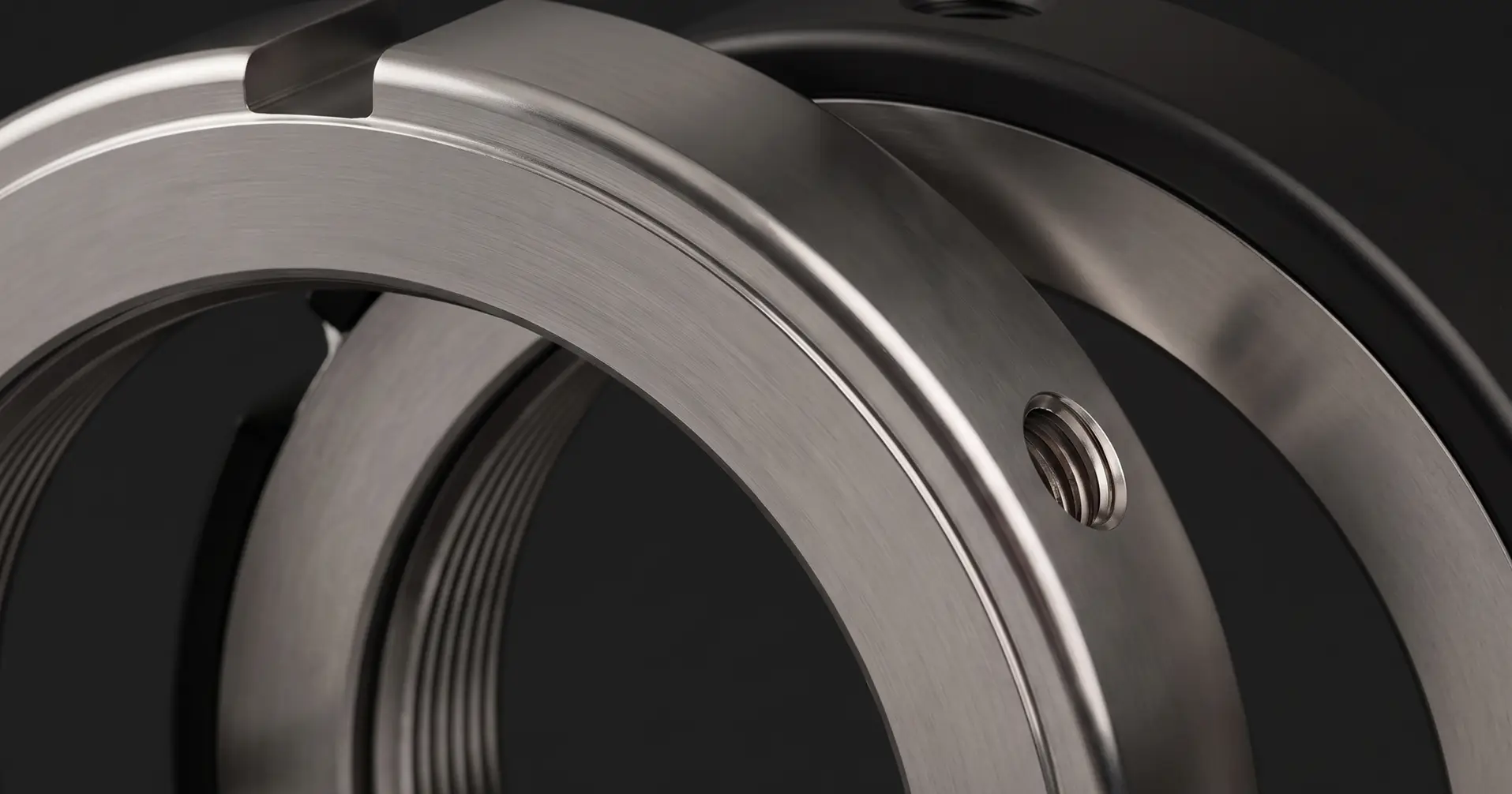
Where MRRA Locknuts Are Used
Assemblies where radial torque rather than the axial envelope sets the specification
Shaft threads that need a larger contact face than a standard nut of that thread provides
Bearing and gear retention on reversing drives
Replacement work, where a plain nut has backed off in service and a bigger face is the fix
Shafts already at their limit for section, where a keyway would take out strength the design needs
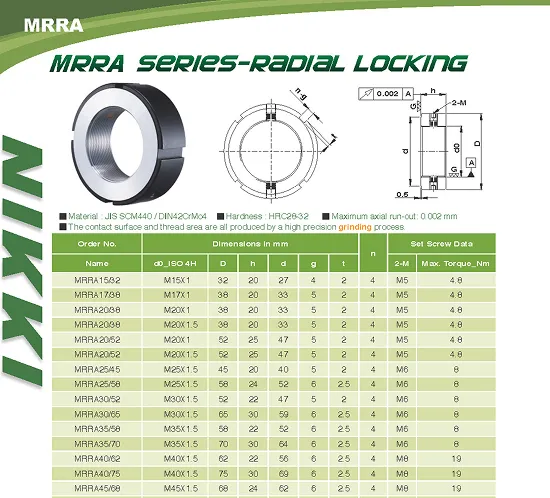

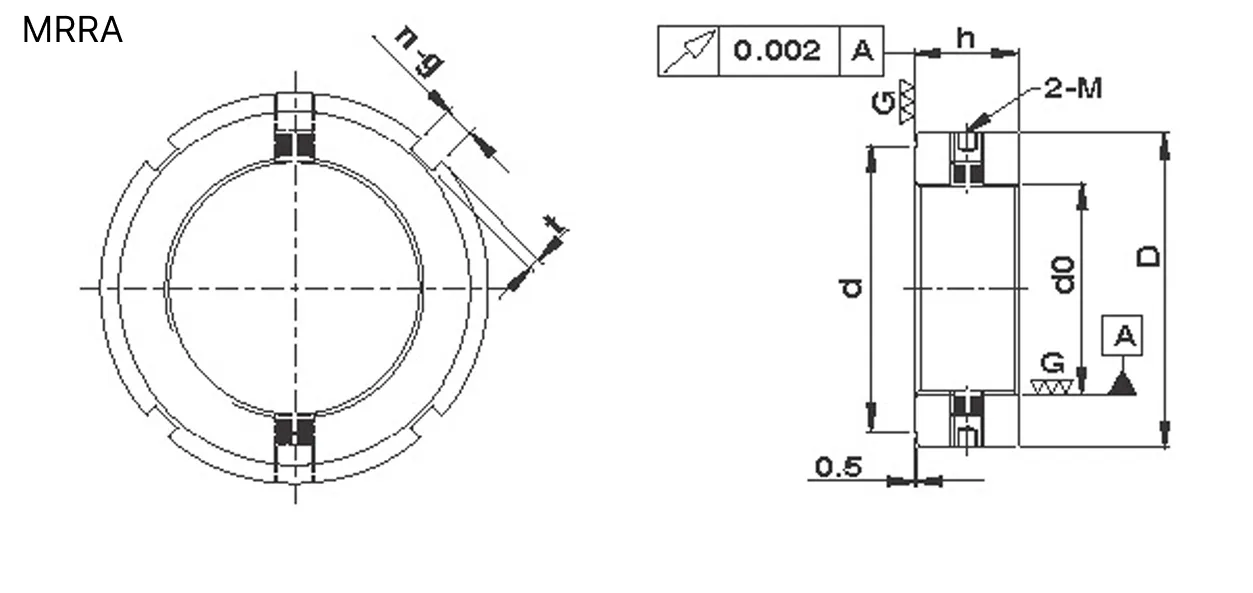
Find Your Size(M15 to M150)
Filter MRRA locknuts by shaft thread, pitch, or height.


Products in this Radial Locking Series
All seven lock the same way, with set screws at 90° driving a pad onto the thread flank, most in a body shorter than the 30° flank equivalent. What differs is the machining grade, the wrench the nut takes, the number of set screws carrying the clamping load, and in two cases the material and the duty the type is built for.
Grinding
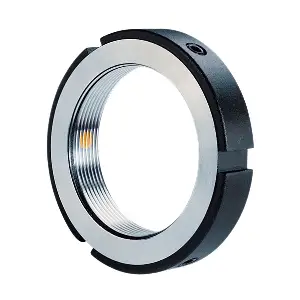
MR
Grinding
Hook wrench · three set screws
M6×0.5 to M260×4 · h 8–30 mm
MR is the general-purpose radial locknut, ground to 0.002 mm, with three set screws at 120° and the widest range in the series. Use it where the drawing calls for the ground grade, and wherever the thread runs above M200 × 3.
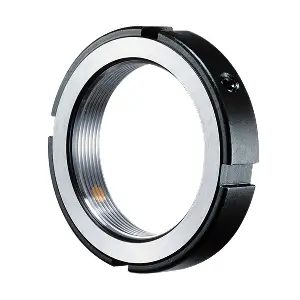
SR
Grinding
Hook wrench · two set screws
M6×0.5 to M200×3 · h 8–32 mm
SR is the two-screw ground type, with four hook slots at every size where MR has three hook slots below M105 and six above, and heavier set screws at the top of the range, M12 at 60 Nm from SR135 where MR stays at M10 and 36 Nm.
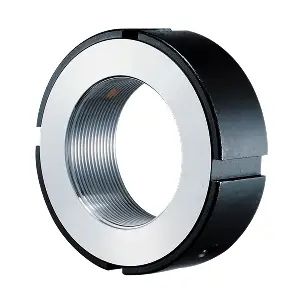
MRRA
Grinding
Hook wrench · two set screws
M15×1 to M150×2 · h 20–42 mm
MRRA is the type for high radial torque, taller and heavier in the body than the rest of the series. Sizes from M20 to M50 are offered in two outside diameters, so the same shaft thread can carry a much larger contact face. Ground only.
Precision turning
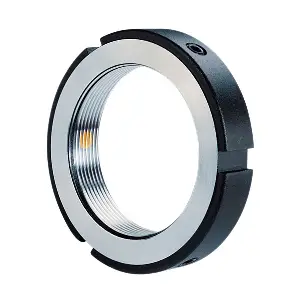
MRZ
Turning
Hook wrench · three set screws
M6×0.5 to M200×3 · h 8–30 mm
MRZ is the precision-turned version of MR at 0.005 mm, matching it size for size up to M200 × 3 and adding fine-pitch rows at M55, M60, M65, M70 and M75 that MR does not carry.
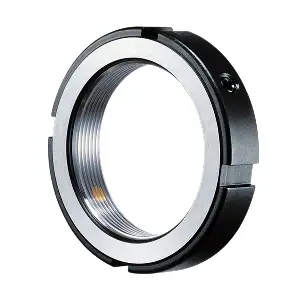
SRZ
Turning
Hook wrench · two set screws
M6×0.5 to M200×3 · h 8–32 mm
SRZ is the precision-turned version of SR, with the same envelope, the same four hook slots and the same set screws at 0.005 mm run-out.
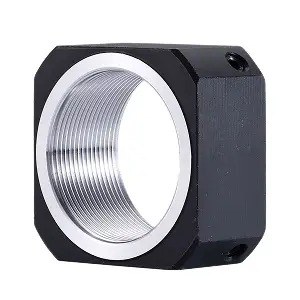
MRN
Turning
Open-end wrench · two flats
M5×0.5 to M40×1.5 · h 5–25 mm
MRN is drawn for light-duty transmission work and takes an ordinary open-end wrench on two flats. It reaches M5 × 0.5 at a 12.5 mm outside diameter, the smallest locknut NIKKI makes.
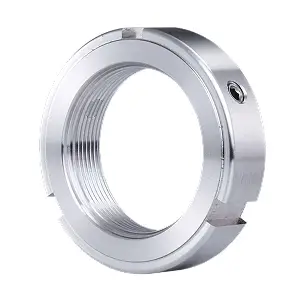
MRS
Turning
Hook wrench · three set screws
M6×0.5 to M50×1.5 · h 8–14 mm
MRS is fully SUS304 stainless, locking pin and set screws included, for food, pharmaceutical, chemical and semiconductor equipment. Dimensionally it matches MRZ across its range.
Tell Us What You Need. We'll Find the Locknut.

Give us the locknut code you use now and we'll find the NIKKI equivalent.

Describe the job, thread size, space, load, and we'll point you to the right NIKKI series.
Questions About the MRRA Locknut
The MRRA is the high radial torque locknut in NIKKI's Radial Locking Series, in metric threads from M15 x 1 to M150 x 2 with 0.002 mm maximum axial run-out. The questions below are the ones buyers ask before a first order.
Contact UsThe maximum axial run-out of an MRRA locknut is 0.002 mm. NIKKI grinds both the thread and the contact surface by a high-precision process, which is what holds the run-out at this level. MRRA is made in the ground grade only; there is no precision-turned version, so no Z code exists for it.
The two numbers are the thread and the outside diameter, not the thread and the pitch used elsewhere in the range. MRRA50/75 is an M50 x 1.5 thread in a 75 mm body, and MRRA50/92 is the same thread in a 92 mm body. Add L for a left-hand thread (MRRA50/75-L) or U for an inch thread (MRRA50/75-U18).
The larger diameter puts more material and a wider contact face around the same shaft thread, which is what lets the nut take higher radial torque. It costs axial length and bore clearance to get it. At M30 x 1.5 the choice runs between a 52 mm body 22 mm high and a 65 mm body 30 mm high, so the housing bore usually settles which one you can fit.
Each MRRA size lists a catalog maximum per screw in the dimension table, from 4.8 Nm on the M5 screws of MRRA15/32 up to 56 Nm on the M12 screws of MRRA150/230. Every size carries two screws. Tighten the pair gradually and alternately rather than one screw fully first.
No, and it isn't meant to be. The other six types trade holding force for a short body; MRRA does the reverse. At M50 x 1.5 it stands 25 mm high in the 75 mm body and 32 mm in the 92 mm body, where MR is 14 mm and even the 30° flank MF is 20 mm. Specify the MR locknut or the SR locknut where axial length is the constraint, and MRRA where the torque is.
No. MRRA locks between the set screws, the brass pads, and the thread flank, all inside the nut, so neither a thrust washer nor a shaft keyway is required. Nothing else goes on the shaft, and the nut is reusable if handled properly.