

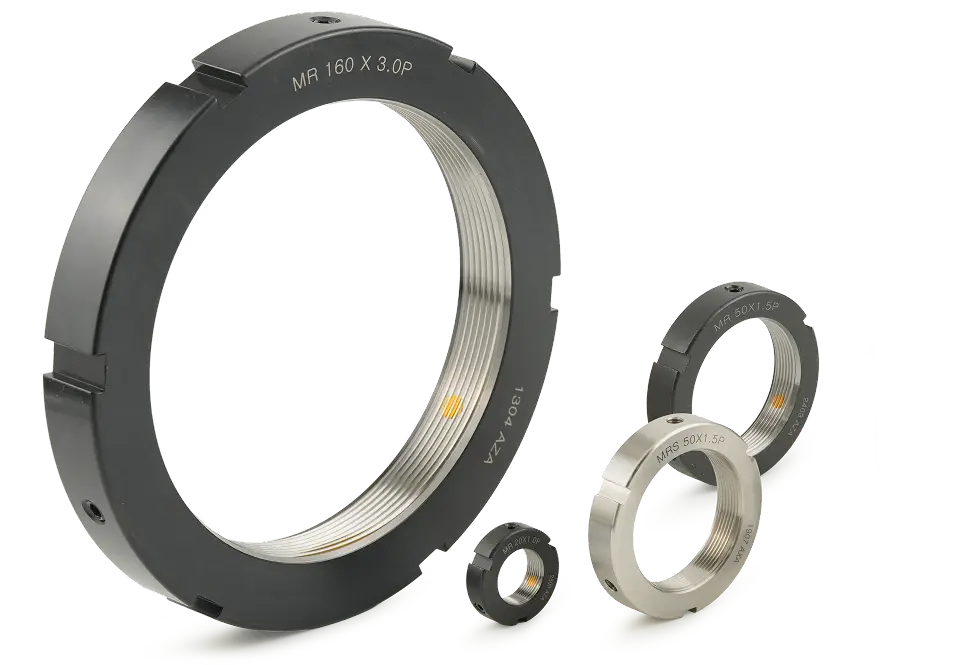

How Radial Locking Works
The set screws in a radial locknut enter through the outside diameter and meet the shaft at 90°. Each one drives a brass pad against the thread flank rather than bearing on the shaft itself, which spreads the clamping load along the flank instead of denting the thread crest. A screw sitting square to the axis needs only its own diameter of height in the body, where an inclined seat has to be given axial length for the angle, and that is where the shorter nut comes from.
Conventional locking works around the problem instead of solving it. A tab washer needs a slot cut in the shaft. A grub screw bearing straight onto the thread deforms it, and the nut is then a single-use part. Because the brass pad rather than the shaft thread is what gives way, a radial locknut comes off and goes back on without damage.


Height · Around half the 30° flank body
Spec: 8 mm against 16 mm at M15 x 1 · 14 against 20 at M50 x 1.5 · 20 against 26 at M100 x 2
The nut that fits where an MF will not go in. On a shaft already at its limit for length, that is often the whole argument.

Shaft · No thrust washer or keyway
Spec: Locking contained inside the nut
The locking happens between the set screws, the brass pads, and the thread flank. Nothing else goes on the shaft, the shaft keeps its full section strength, and a machining operation comes off the drawing.

Grades · Two finishes, one geometry
Spec: 0.002 mm ground · 0.005 mm precision turned
MR and MRZ share an envelope from M40 x 1.5 upward, as do SR and SRZ across their whole range. You pay for the tighter run-out where the application justifies it and take the turned grade where it doesn't, without redesigning the housing around a different nut.

Material · Stainless in the same envelope
Spec: JIS SUS304 throughout · M6 x 0.5 to M50 x 1.5
MRS is stainless including the locking pin and set screws, and matches MRZ dimensionally across its range. It suits food, pharmaceutical, chemical and semiconductor equipment.
Choosing Between MR, MRZ, SR, SRZ, MRRA, MRN and MRS
All seven lock the same way, with set screws at 90° driving a pad onto the thread flank, most in a body shorter than the 30° flank equivalent. What differs is the machining grade, the wrench the nut takes, the number of set screws carrying the clamping load, and in two cases the material and the duty the type is built for.
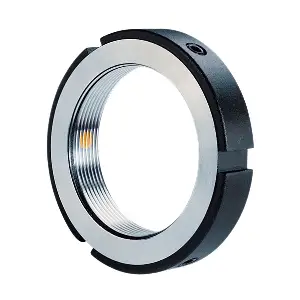
MR
Grinding
Hook wrench · three set screws; three hook slots below M105, six above
M6×0.5 to M260×4 · h 8–30 mm
MR is the general-purpose radial locknut, ground to 0.002 mm, with three set screws at 120° and the widest range in the series. Use it where the drawing calls for the ground grade, and wherever the thread runs above M200 × 3.
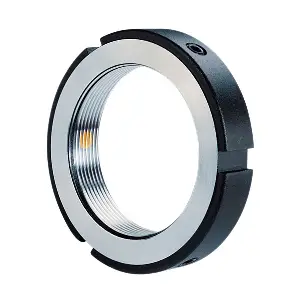
MRZ
Turning
Hook wrench · three set screws; three hook slots below M105, six above
M6×0.5 to M200×3 · h 8–30 mm
MRZ is the precision-turned version of MR at 0.005 mm, matching it size for size up to M200 × 3 and adding fine-pitch rows at M55, M60, M65, M70 and M75 that MR does not carry.
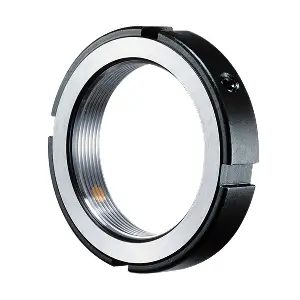
SR
Grinding
Hook wrench · two set screws
M6×0.5 to M200×3 · h 8–32 mm
SR is the two-screw ground type, with four hook slots at every size where MR has three hook slots below M105 and six above, and heavier set screws at the top of the range, M12 at 60 Nm from SR135 where MR stays at M10 and 36 Nm.
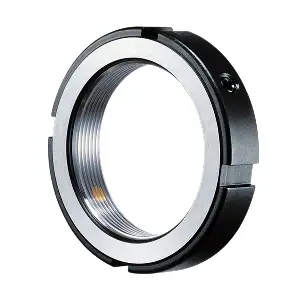
SRZ
Turning
Hook wrench · two set screws
M6×0.5 to M200×3 · h 8–32 mm
SRZ is the precision-turned version of SR, with the same envelope, the same four hook slots and the same set screws at 0.005 mm run-out.
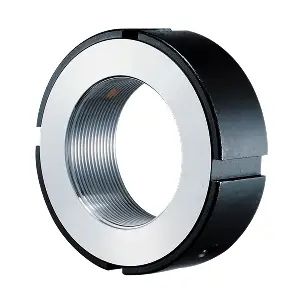
MRRA
Grinding
Hook wrench · two set screws
M15×1 to M150×2 · h 20–42 mm
MRRA is the type for high radial torque, taller and heavier in the body than the rest of the series. Sizes from M20 to M50 are offered in two outside diameters, so the same shaft thread can carry a much larger contact face. Ground only.
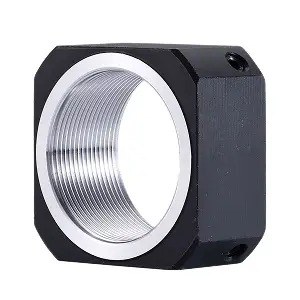
MRN
Turning
Open-end wrench · two flats
M5×0.5 to M40×1.5 · h 5–25 mm
MRN is drawn for light-duty transmission work and takes an ordinary open-end wrench on two flats. It reaches M5 × 0.5 at a 12.5 mm outside diameter, the smallest locknut NIKKI makes.
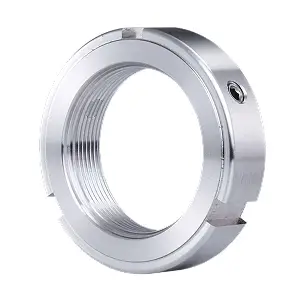
MRS
Turning
Hook wrench · three set screws
M6×0.5 to M50×1.5 · h 8–14 mm
MRS is fully SUS304 stainless, locking pin and set screws included, for food, pharmaceutical, chemical and semiconductor equipment. Dimensionally it matches MRZ across its range.
Radial Locknut Applications
These are the locknuts for assemblies where the shaft has run out of length. Anywhere a bearing, gear or pulley has to be retained on a threaded shaft and the axial envelope is tight is a candidate.
Compact gearboxes and reducers
Bearing and gear retention where the housing was drawn around a shorter nut and a 30° flank body simply will not go in.
Robot joints and small drives
Joint reducers and compact servo drives, where every millimeter of axial length is contested and the assembly still has to hold position under reversing torque.
Pumps, fans, and blowers
Impeller and rotor retention. Continuous rotation with some out-of-balance load is exactly the condition that backs a plain nut off.
Light transmission work
Small shafts down to M5 x 0.5, on drives built and serviced with ordinary hand tools. That is what MRN is for.
Food, pharmaceutical, chemical, and semiconductor equipment
Washdown, corrosive, and clean environments where the nut has to be stainless throughout, locking pin and screws included. MRS covers these to M50 x 1.5.
Shafts that can't take a keyway
Cutting a slot removes the section where the shaft is often already at its limit. Radial locking needs no slot, so the shaft keeps its strength.
Cost-driven builds
Machinery where a turned-grade nut at 0.005 mm meets the drawing, and the budget won't carry a ground one.
Shared Specifications
- Material
JIS SCM440 / DIN 42CrMo4 / AISI 4140, alloy steel for quenching and tempering per ISO 683-2. MRS is JIS SUS304 stainless throughout
- Hardness
HRC 28-32 on the SCM440 types
- Thread Precision
ISO 4H per ISO 965-1
- Maximum Axial Run-Out
0.002 mm on MR, SR, MRRA; 0.005 mm on MRZ, SRZ, MRN, MRS
- Locking Method
Set screws meeting the shaft at 90°, each driving a brass pad onto the thread flank. MRS uses a stainless pin in place of the brass
- Set Screws
Two or three per nut depending on type. M3 to M12, 0.9 to 60 Nm maximum per screw. MR, MRZ and MRS carry three; SR, SRZ, MRN and MRRA carry two. MRN takes the smallest at M3 and 0.9 Nm; SR and SRZ the largest at M12 and 60 Nm from size 135.
- Body Height
5 to 42 mm across the seven types, against 14 to 40 mm on the 30° flank series
- Tightening
Hook wrench on MR, MRZ, SR, SRZ, MRRA and MRS. Open-end wrench on MRN, which carries two flats
- Surface Finishing
Thread and contact surface ground (MR, SR, MRRA) or precision turned (MRZ, SRZ, MRN, MRS)
- Locking Accessories
None required
- Reusability
Reusable if handled properly
Tell Us What You Need. We'll Find the Locknut.

Give us the locknut code you use now and we'll find the NIKKI equivalent.

Describe the job, thread size, space, load, and we'll point you to the right NIKKI series.
Questions About the Radial Locking Series
The Radial Locking Series covers seven locknut types in metric threads from M5 x 0.5 to M260 x 4, each locking through set screws that meet the shaft at 90° and drive a brass pad onto the thread flank, in a body around half the height of the equivalent 30° flank nut. The questions below are the ones buyers ask before a first order.
Contact UsEach set screw in a NIKKI radial locknut meets the shaft at 90° and drives a brass pad against the thread flank. The pad grips the flank rather than the thread crest, which gives enough holding force to resist vibration without deforming the shaft. No slot, washer, or tab is needed, and the nut can be taken off and refitted.
MR carries three set screws at 120°, with three hook slots below M105 and six above. SR carries two set screws and four slots at every size, and takes heavier screws at the large end, M12 at 60 Nm from SR135 where MR stays at M10 and 36 Nm.
Both are ground to 0.002 mm in SCM440 at HRC 28-32. MR continues to M260 x 4, while SR stops at M200 x 3.
Grinding grade (MR, SR, MRRA) has both the thread and the contact face ground, holding maximum axial run-out to 0.002 mm. Precision-turning grade (MRZ, SRZ, MRN, MRS) is finished by precision turning at 0.005 mm, and costs less.
Material, hardness, and ISO 4H thread class are the same on both. The grade is in the model code: a Z means precision turned, so MRZ is the turned version of MR.
Choose the 30° Flank Locking Series where the housing has room for a taller nut and nothing is gained by a shorter one. Those types run 14 to 40 mm high, where a radial nut on the same thread is typically a third to a half shorter.
Where preload stability rather than height sets the limit on the machine, look at the Ultra-Uniform Locking Series.
The seven types together cover metric threads from M5 x 0.5 up to M260 x 4, with outside diameters from 12.5 to 320 mm. Left-hand threads are ordered by adding L to the code. Inch threads replace the metric pitch with the TPI, for example MR30-U18. Full dimension tables are on each type's page.