


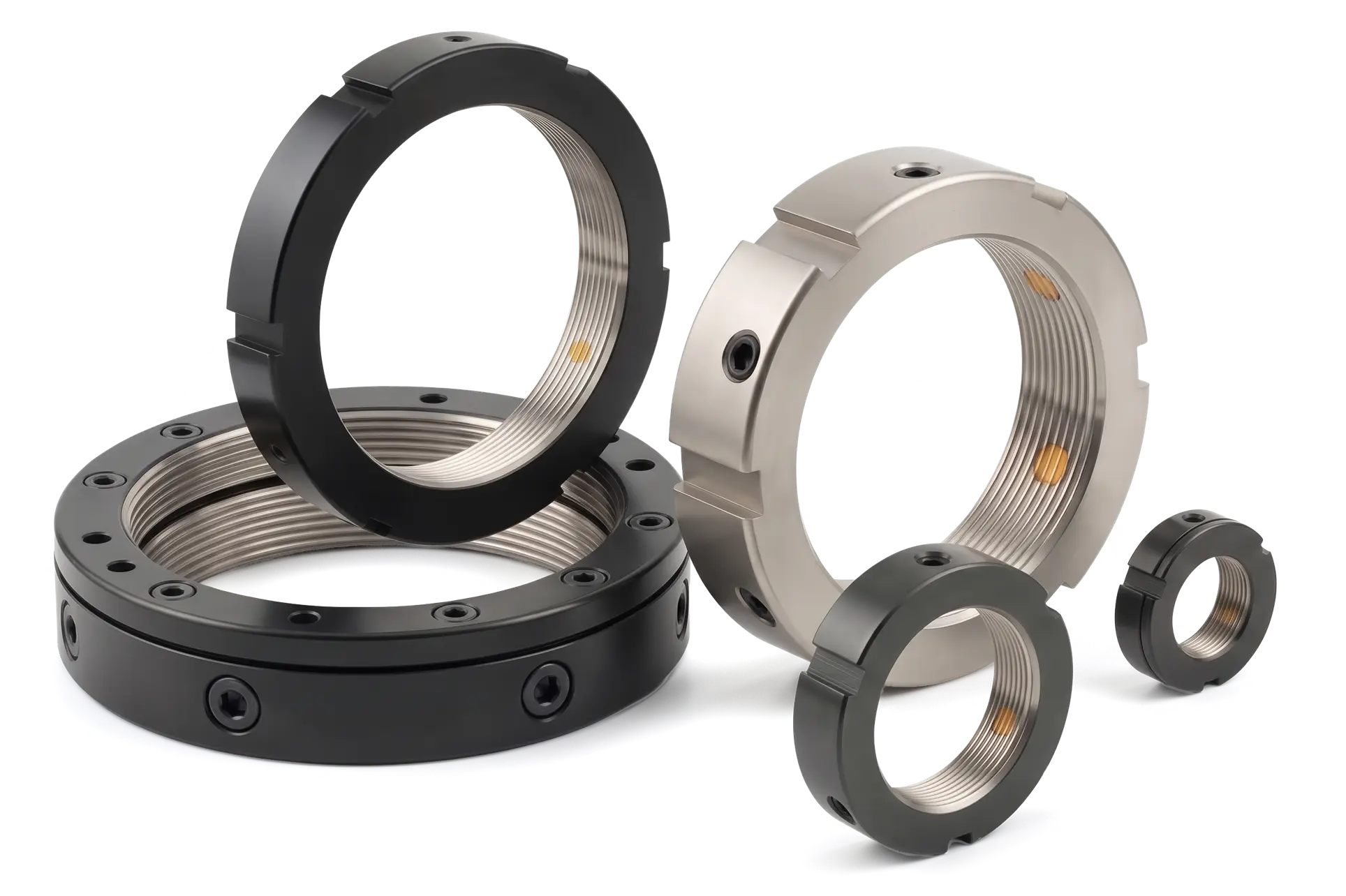

If a Standard Locknut Cannot Meet the Specification
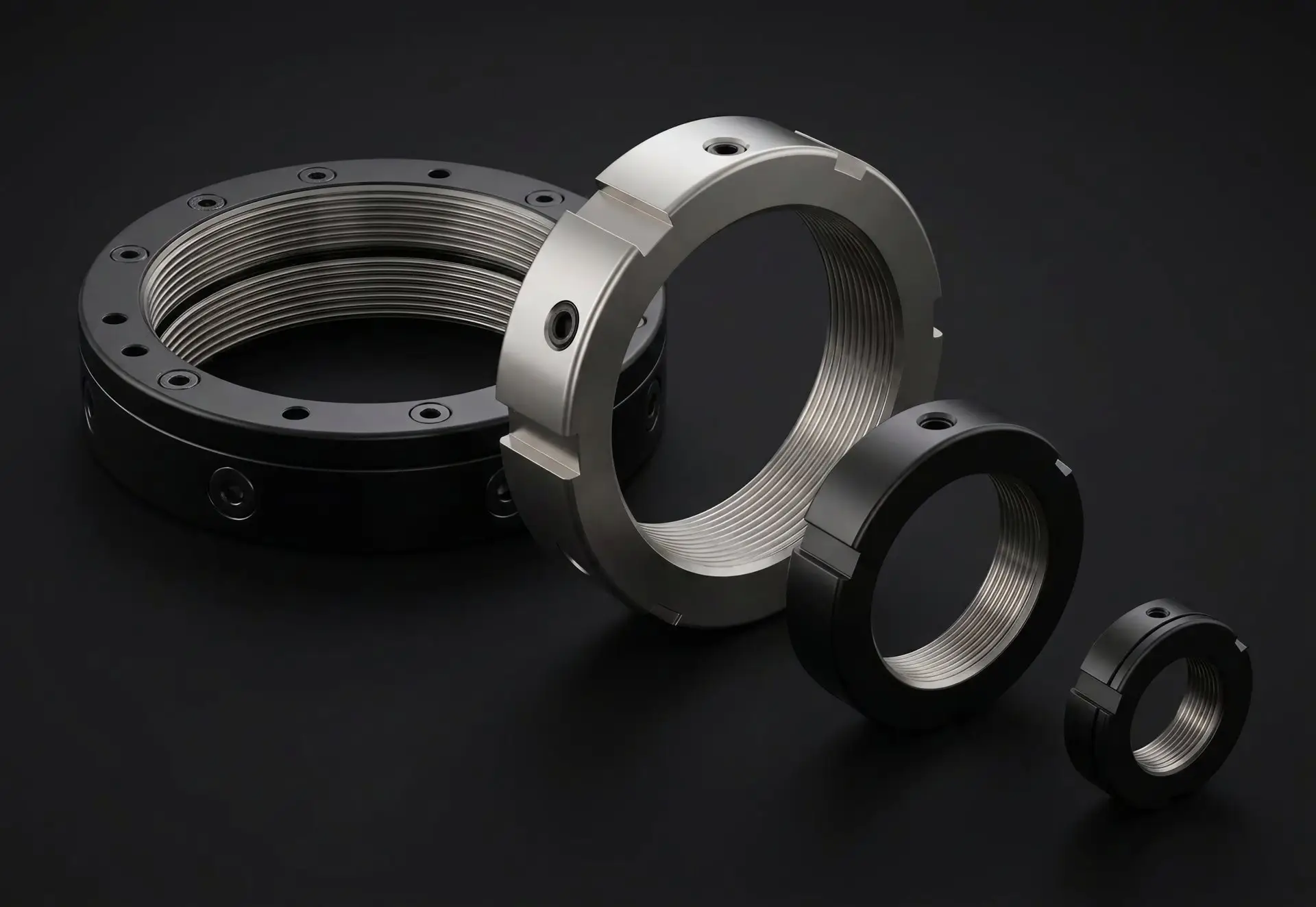
A locknut moves outside the standard range for one of four reasons: the envelope is too tight for the catalogue body, the drawing calls for accuracy above the standard machining grade, the design requires a feature the standard body does not carry, or the thread lies outside the listed sizes. On spindle work these seldom appear on their own, and a single drawing will often call for three of them at once.
The part underneath remains the same. A custom NIKKI locknut is machined from the same alloy steel, heat treated to the same hardness and locks on the same principle as the standard series, so what you receive is a variation on geometry we already produce in quantity.


Ground faces where needed
On a spindle, the ground rear face is often the single reason the standard nut will not meet requirements, since it is the surface that sets the bearing seat square. Outer diameter, clamping face and rear face are all ground to drawing, to 0.002 mm axial run-out.

Balanced for high rpm
Built-in and direct-drive motor spindles often need residual imbalance taken out of the nut itself rather than corrected elsewhere in the stack. Balancing holes are produced to the count, diameter and angular spacing the drawing specifies.

Any thread we can cut, up to M320
Non-standard pitches, left-hand threads, inch threads and sizes between the catalogue steps. Threading is done here, so a thread outside the standard range adds no outside process and no third party to the lead time.

Quoted against your drawing
We price the part in front of us, not the nearest catalogue equivalent plus a machining charge. Most enquiries reach us as a drawing, and that is usually all we need to quote.
What Can Be Customized in a Locknut
These are the types of customization work most commonly required
Dimensions and accuracy
Set Screw Count and PositionHook SlotsFace Pin HolesHex Flats
The wrench interface is often the only thing that has to change, particularly where a nut sits deep in a housing and the fitter can reach it from one direction only.
Outside DiameterHeightBore and Seat Features
A wider contact face to spread load, a thinner body to fit a tight envelope, or relief grooves and chamfers cut to clear a shoulder or accept a seal.
Outer DiameterClamping FaceRear Face
Grinding grade holds axial run-out to 0.002 mm. Where a drawing specifies parallelism or concentricity separately, we quote against the drawing rather than the grade.
Features and material
M5 to M320Left-HandInchNon-Standard Pitch
Threads between the catalogue steps are common on retrofit work, where the shaft was cut long before anybody considered which nut would go on it.
SCM440SUS304Alternative Hardness
SCM440 at HRC 28-32 is standard. SUS304 throughout, locking pins and set screws included, covers food, pharmaceutical, chemical and semiconductor equipment.
Balancing Holes to Drawing
Hole count, diameter and angular spacing are set by the drawing. Where the spindle builder gives a residual imbalance figure instead, send that.
If the change you need is not listed, send the drawing anyway. Very little of what we make to order appears in the catalogue.
Modified Standard or Made from Scratch
Custom work arrives in two forms, and it is worth establishing which one you have before asking for a price. A modification takes an existing NIKKI type and alters the outside diameter, the height, the grinding specification or the wrench interface.
The geometry is proven and the tooling largely exists, so the quotation and the sample both come back faster.
A part drawn from nothing is the right route where the envelope, the locking arrangement or the interface has no catalogue ancestor at all. Tell us which situation you are in and we will say plainly whether a modification will get you there.

Other Locknut Series Available
Before commissioning a custom part, check whether a standard series already covers it.
The 30° Flank Locking Series (MF, BF, TMF, SFZ, MFZ, BFZ) covers most general machinery, and the Radial Locking Series suits a thin nut locking from the outside diameter. Where the outside diameter is inaccessible after assembly, the Axial Locking Series locks from the front.
Where running accuracy rather than space sets the limit, look at the Ultra-Uniform Locking Series.
Customized Locknut Applications
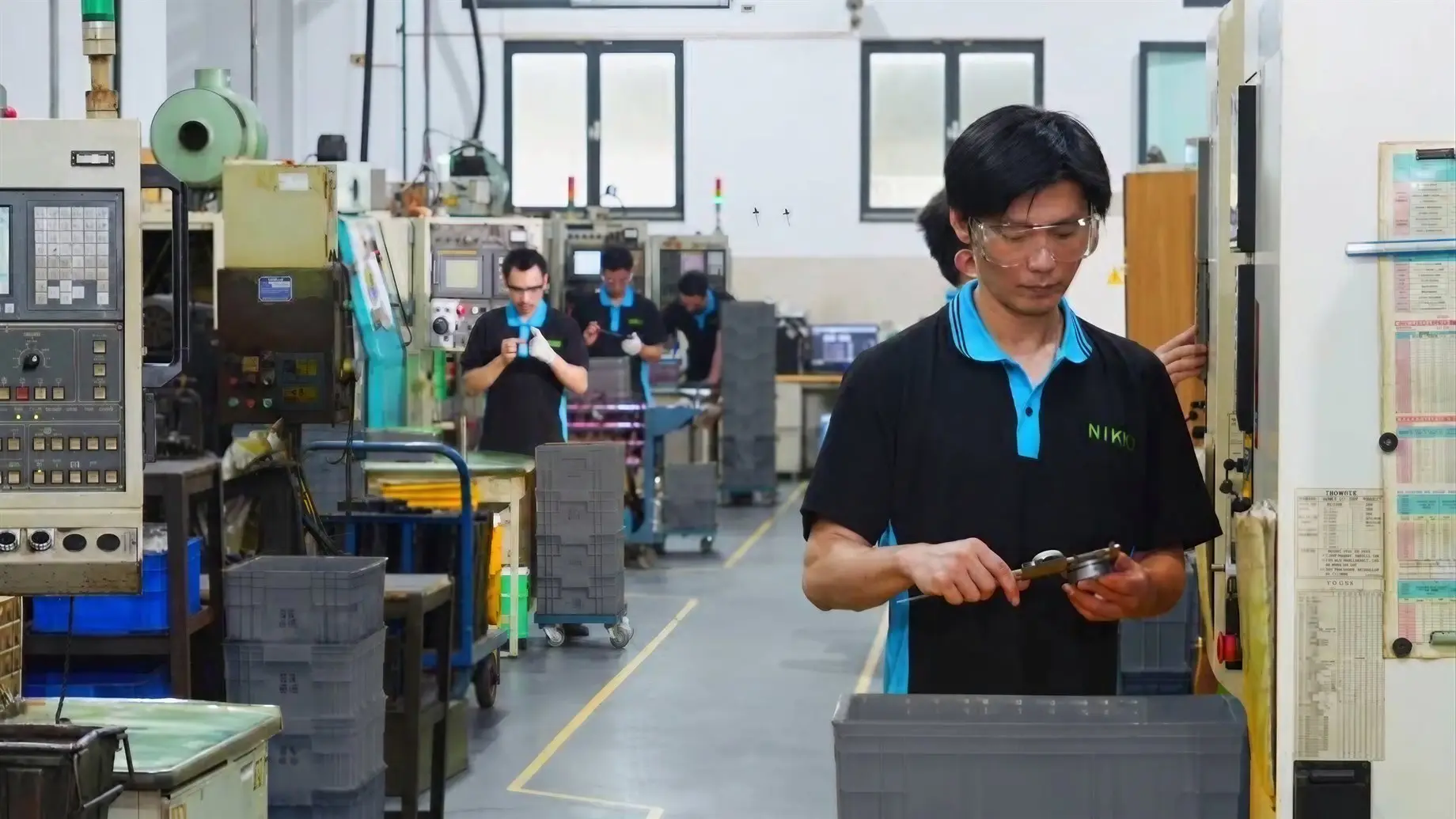
Customized locknuts go where the standard range runs out before the requirement does. Spindle work accounts for a good deal of it, though far from all.
High-speed and direct-drive spindles
Ground outer diameter and rear face, with balancing holes taken out to the spindle builder's specification.
Robot joints and precision reducers
Reversing torque all day, in an axial envelope every other component is also competing for.
Test rigs and prototype machines
Housings that no standard nut fits, on machines nobody is going to redesign to suit the nut.
Shafts that cannot take a keyway
Cutting a slot removes section where the shaft is often already at its limit, and a custom body can carry the locking instead.
Grinding machines and ball screw support bearings
Preload that has to hold against continuous reversing load, on machines where a shift of a few microns shows up in the workpiece.
Large shafts above the standard range
Heavy machinery where the thread runs past anything a catalogue carries. Our in-house range reaches M320.
Semiconductor, vacuum and clean environments
Material, surface condition and cleanliness set by the customer rather than by us.
OEM repeat orders
A recurring requirement made to the customer's own specification rather than to a catalogue code.
Shared Specifications
- Thread range
M5 to M320, produced in house
- Processes
CNC turning, threading, special machining, precision grinding
- Material
JIS SCM440 / DIN 42CrMo4, alloy steel for quenching and tempering per ISO 683-2. JIS SUS304 and other materials on request
- Hardness
HRC 28-32 standard, other ranges on request
- Thread precision
ISO 4H per ISO 965-1, or to drawing
- Maximum axial run-out
0.002 mm ground, 0.005 mm precision turned, or to drawing
- Balancing features
Balancing holes, count and spacing to drawing
- Wrench interface
Hook slots, face pin holes, spanner holes, hex flats
- Basis of manufacture
Customer drawing
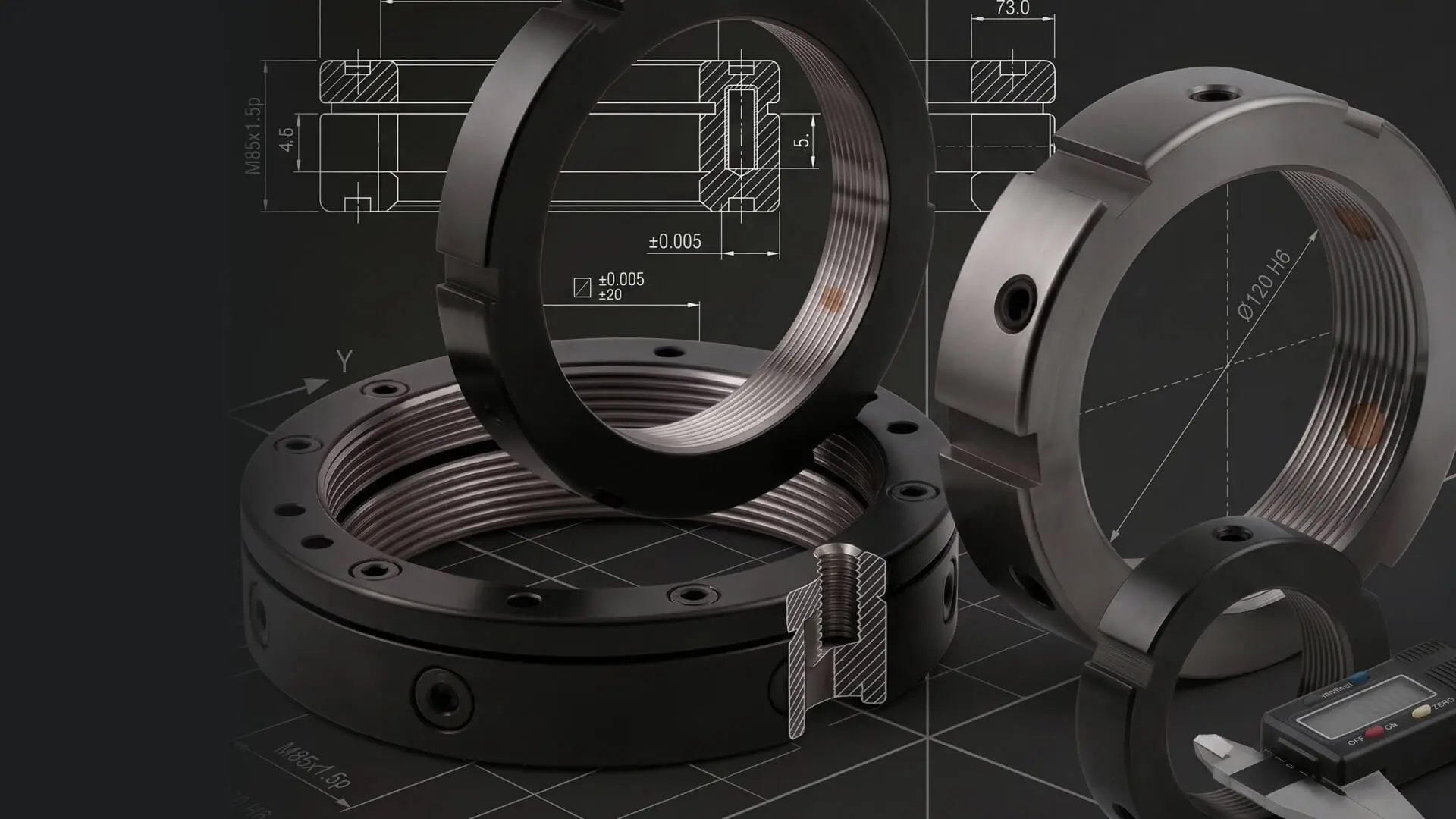
Send Us the Drawing.
We'll Quote the Part.
A drawing and a quantity are usually enough. No drawing yet? The thread, the envelope and what the nut has to hold will get us started.
Questions About Customized Locknuts
Customized locknuts are made to the customer's own drawing, in threads from M5 to M320, with turning, threading, special machining and grinding all in house. The questions below are the ones buyers ask before sending a drawing for quotation.
Contact UsA dimensioned drawing showing the thread, outside diameter, height, the tolerances that matter and the material, together with the quantity expected. Where the nut is for a spindle, include the operating speed and any residual imbalance figure the spindle builder has specified. NIKKI quotes customized locknuts against the drawing rather than against the nearest catalogue part.
In most cases, yes. Customers send us a technical drawing and we manufacture to the dimensions, tolerances and features it specifies. Where no drawing exists, send the thread size, the space available and what the nut has to do, and our engineers will tell you what else is needed before we can price the part.
NIKKI's in-house range runs to M320, covering CNC turning, threading, special machining and precision grinding on one site. Threads above the standard catalogue range are handled as custom work, and large-diameter parts are usually specified for heavy machinery where no catalogue nut reaches the thread size.
NIKKI holds maximum axial run-out to 0.002 mm on ground parts and 0.005 mm on precision-turned parts, with ISO 4H thread precision in SCM440 at HRC 28-32. Where a drawing specifies parallelism, concentricity or run-out beyond the standard grades, we review the drawing and quote against the figures on it.
Yes, and it is usually the faster and cheaper route. Altering the outside diameter, height, grinding specification or wrench interface of a standard NIKKI type keeps geometry already proven in production, so the quotation and the sample come back sooner than they would for a part drawn from nothing.
JIS SCM440 chromium-molybdenum steel (DIN 42CrMo4) at HRC 28-32 is standard, with the thread and contact surface ground to ISO 4H thread precision. JIS SUS304 stainless throughout, including locking pins and set screws, is available for food, pharmaceutical, chemical and semiconductor equipment. Other materials and hardness ranges are quoted on request.