


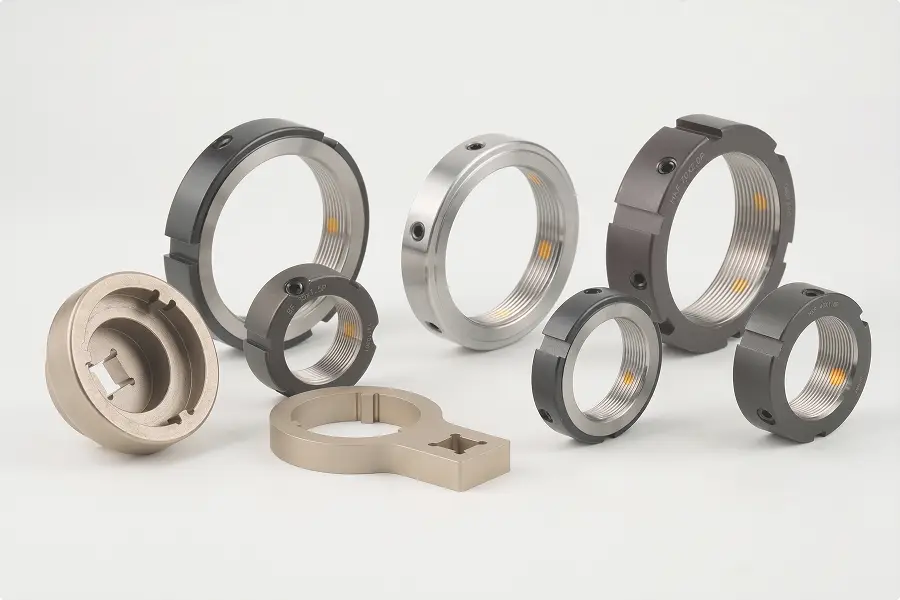
NIKKI precision locknuts are made in two machining grades. Grinding grade has the thread and the contact face both ground, holding maximum axial run-out to 0.002 mm. Precision-turning grade is finished by precision turning at 0.005 mm and costs less. Material, hardness and thread class are the same on both.
Both grades are cut and finished in Taichung, where HSIANG KAI FU has made NIKKI locknuts since 1994. The split runs through the whole catalog, so the same decision faces you whether you are specifying from the 30° flank locking series or the thin radial locking series.
What Separates Grinding Grade From Precision-Turning Grade
Both grades are machined from JIS SCM440 / DIN 42CrMo4 alloy steel per ISO 683-2 at HRC 28-32, with threads cut to class 4H per ISO 965-1. Only the finishing operation changes. On grinding grade we grind the thread and the contact face; on the turned grade both are finished by precision turning, at 0.005 mm rather than 0.002 mm.
Contact surface roughness matters rather more than the run-out figure alone suggests. A smoother face seats the bearing evenly across the whole contact area, which is what keeps the preload where you set it once the assembly is turning at speed.
| Property | Grinding grade | Precision-turning grade |
|---|---|---|
| Maximum axial run-out | 0.002 mm | 0.005 mm |
| Finishing | Thread and contact face ground | Thread and contact face precision turned |
| Model code | No Z (MF, BF, MR, SR) | Z (MFZ, BFZ, MRZ, SRZ) |
| Material and hardness | SCM440 / 42CrMo4, HRC 28-32 | SCM440 / 42CrMo4, HRC 28-32 |
| Typical application | Spindles, ball screws, high-speed axes | Gearboxes, pumps, conveyors |
The Grade Is Written Into the Model Code
A code carrying Z is precision-turning grade; a code without it is grinding grade. MF and MFZ are the same nut in two finishes, as are BF and BFZ, MR and MRZ, SR and SRZ. Most competitor codes mark only the nut type, which leaves the grade to be confirmed by email before anyone can quote.
Types Made in One Grade Only
SFZ, MRN and MRS are turned grade only. In the axial locking series the split works differently again. MA is ground on the thread and the face (0.002 mm), while MKR, MKK and MKW have the contact face ground alone (0.005 mm).
When to Specify 0.002 mm Axial Run-Out
Specify grinding grade where run-out at the nut face carries straight into the running accuracy of the machine. That means machine tool spindles, ball screw support bearings, high-speed rotating assemblies and precision positioning axes, where a few microns at the seat show up as surface finish or lost repeatability. Precision turning covers gearboxes, pumps, fans, conveyors and general transmission work, where the drawing allows 0.005 mm. Neither grade is the safe default. Paying for 0.002 mm on a conveyor drum buys a tolerance nobody will measure.
Do the Two Grades Swap in the Same Housing?
MF and MFZ share an envelope, so the two swap without redrawing anything. MR and MRZ match from M40 x 1.5 upward. Below that the MR body runs a few millimeters larger across the outside diameter, so check the bore before treating them as equivalents.
If you are not certain which grade your current part is, the cross-reference tool will place most competitor codes.
FAQ
Grinding grade has both the thread and the contact face finished by a high-precision grinding process, holding maximum axial run-out to 0.002 mm. Precision-turning grade is finished by precision turning at 0.005 mm and costs less. Material, hardness and ISO 4H thread class are identical on both, so the choice concerns surface finish and run-out rather than strength.
A Z marks precision-turning grade, so MFZ is the turned version of MF, MRZ of MR, BFZ of BF and SRZ of SR, while a code without a Z is grinding grade at 0.002 mm.
MF, BF and TMF in the 30° flank series; MR, SR and MRRA in the radial series; HKF and HKR in the ultra-uniform series; and MA in the axial series, all at 0.002 mm with the thread and contact face both ground.
The two grades use the same material. Both are machined from JIS SCM440 chromium-molybdenum steel (DIN 42CrMo4, AISI 4140), quenched and tempered to HRC 28-32, with threads cut to ISO 4H. Only the finishing operation differs.
A precision-turned locknut usually swaps for the ground version, though it is worth checking first. MF and MFZ share an envelope across the full range, as do SR and SRZ. MR and MRZ match from M40 x 1.5 upward; below that MR carries a larger outside diameter, so the two are not always interchangeable in a tight bore.
Grinding grade costs enough more to be worth specifying deliberately rather than by default. It adds a finishing operation on both the thread and the face, so the difference grows with size. Where a drawing allows 0.005 mm, the turned grade is the sensible choice.
A run-out of 0.005 mm suits most general machinery: gearbox and reducer shafts, pump and fan rotors, conveyor and roller assemblies, couplings and pulleys on motor shafts. What matters is whether run-out at the nut face feeds into the accuracy the machine is sold on. If it does not, the turned grade is enough.
We check thread class against gauges to ISO 4H. Thickness, inner diameter and thread run-out are measured on a universal length measuring instrument, a universal measuring microscope, and a roughness and contour instrument. We can supply inspection records against your own order rather than a generic certificate.
MA is ground on the thread area and the contact surface, at 0.002 mm. MKR, MKK and MKW have the contact surface ground but not the thread area, so they hold 0.005 mm. The axial series is the one place where the grade split does not follow the Z convention, so read it from the type rather than the code.
On a NIKKI part, read the code: a Z means precision turned. On another maker's part the code often will not say, so either measure the run-out at the contact face or send us the part number with the shaft drawing. The locknut cross-reference will place most competitor codes and return the matching NIKKI grade.